Jump to content

The Astonishing Story Behind XIV Debacle


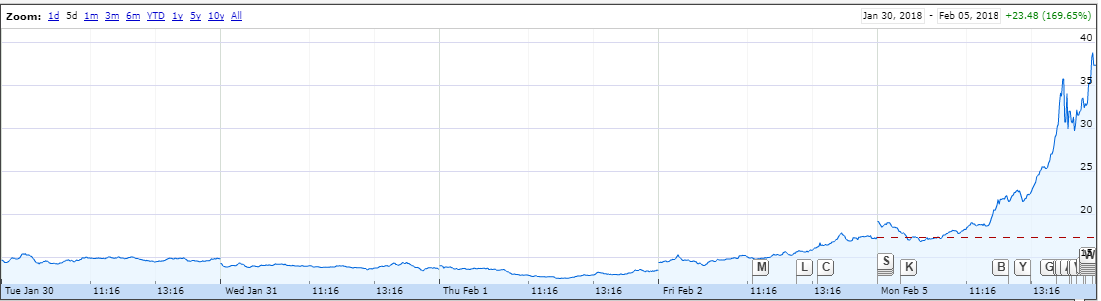
During the market's closing hour on Monday, February 5th, some sort of "flash crash," likely triggered by margin calls, attacked the CBOE Volatility Index (INDEXCBOE:VIX), also known as the "fear index." What was a bad day, turned into a never before seen move. Here is it: 

VIX2718.png


Whatever it was, the VIX went from 17% to 37% in a matter of two-hours, or up 115%. That is the largest percentage gain in the VIX in one day ever recorded. 


Even then, while that is a huge move, it wasn't really market disruptive in any great way other than, the market had a bad day. But then the after hours margin calls came in -- and that was an unmitigated disaster for one particular instrument of interest to us: Credit Suisse AG - VelocityShares Daily Inverse VIX Short Term ETN (NASDAQ:XIV). 

DON'T LISTEN TO TV 
The reporters on television have no understanding what XIV is -- it is not a naked short bet on VIX. No, it is an investment in the core underlying principle of market structures, driven by positive interest rates, known as Contango. 

Remember, the XIV is the opposite of VXX, and the expected value of VXX is zero. Here it is, from the actual VXX prospectus: 
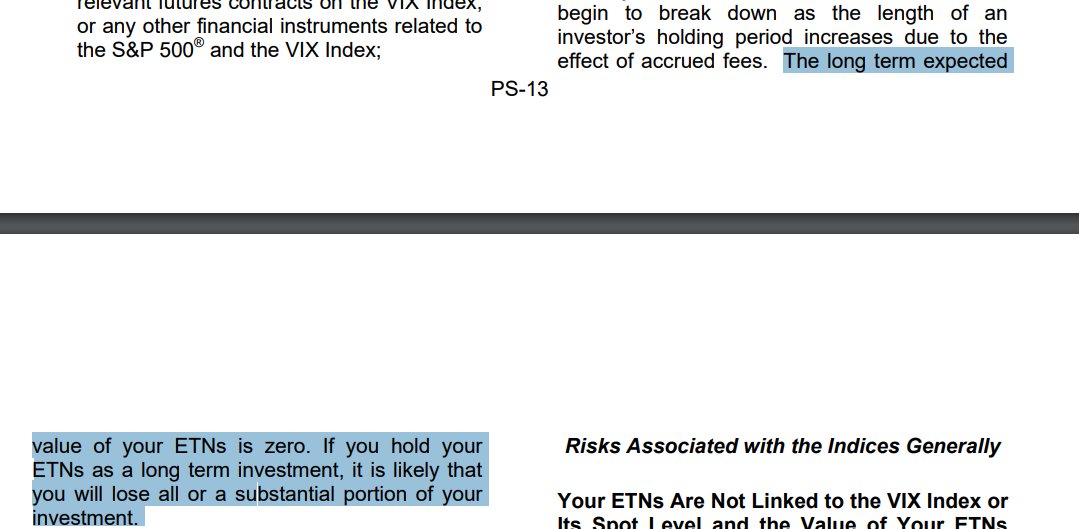
 

vxxzero.jpg


This instrument is not a radical short trade, it is fundamentally an investment in an ETN that reverses the value of an investment that is ultimately expected to be zero, which made it so good, for so long, and would have for several more decades. 

WHEN A LINE BECOMES THE FOCUS 
A little detail in the prospectus of XIV is that, hypothetically, should it lose 80% of its value from the close, it would cause a "acceleration event." That means that if the XIV sunk to 20% of its value, it would go to zero and the ETN would go away (and start over later). 

Now, obviously, this had never happened to XIV before, but it's only a decade old. When scientists back-tested XIV all the way back to the 1987 crash and including the 9/11 terror attacks, they noted that even then, XIV would not have suffered a 80% decline in a day. But we have never seen such a market with so many naked short vol sellers as we have today. 

As a barometer, even as crazed as Monday was, here is how XIV closed: 

XIVclose2718.png


Down 14.32% is ugly, but, it's just a day -- a bad one, but nothing really all that crazed. Then the after hours session happened, and the best anyone can tell, as of this writing, is that some firm (or fund) had to unwind a short volatility position due to a margin call. 

That meant they had to buy the front month expiration of the VIX futures, leaving the second month unchanged. That little detail is everything, because the XIV is an investment on contango -- when the second month is priced higher than the first month. This is a market structure apparatus -- we could call it "normal market structure." 

But, with a flood of buying to cover short front month futures, the XIV started tumbling after hours. At first, social media saw it as a buying opportunity. Then it started dropping faster. Then disaster struck. 

The XIV dropped more than 80%: 

XIVah2718.png


The financial press did its best to cover it, but after a 2 minute segment on CNBC, there was nothing left to say because of one major rule inside the XIV prospectus. Here it is: 

 

xivacc.png


In that fine print, it reads that if the value of XIV dips to 20% of the closing value (if it is down 80%), the fund stops. That is, since this trade, if done with actual futures contracts, can actually go negative, the ETN stops itself out at a 80% one day loss. This is why we investors use the ETN, knowing that a 100% loss is the worst that can happen, as opposed to the futures, where much worse than 100% loss can occur. 

And the greatest burn of it all 
As of Tuesday morning the VIX is down huge (of course it is), the market structure has held (of course it did), and XIV would be having a very good day (of course it would). 

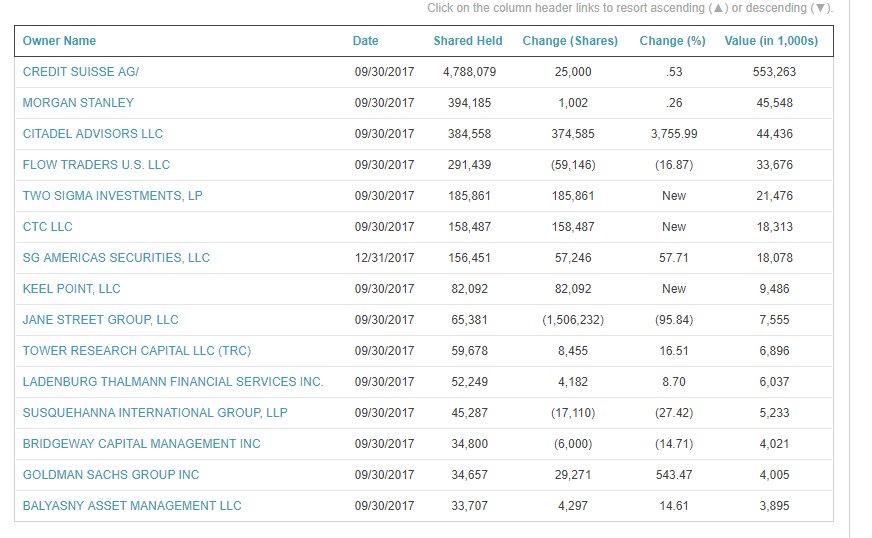
But, worse --- it turns out, as far as we know (still speculation), while it's hard to swallow, that the unwinding was done by none other than Credit Suisse itself. Yes, the creators of the ETN had another concern, beyond the assets under management -- and here it is -- -- look at the largest shareholder
 

xivholders.jpg

Credit Suisse quietly became the single largest holder of the very instrument it created, and by a huge amount. So, as 4pm EST came around, a bad day in XIV, but survivable, became the death knell, because the largest holder, the XIV's custodian, panicked, and covered. 

But, Credit Suisse could not very well just sell millions of shares of XIV in a thinly traded after hours session, so it turned to the VIX futures market. 

It appears, as of this writing, that this has actually occurred. While Credit Suisse (the issuer of the ETN) has yet to comment, it appears that whatever this "flash crash" did, whatever margin calls were triggered after hours, the short vol trader was in fact the firm -- it unwound positions in a size that the market has never seen before, and that means that it looks like XIV is possibly going to some very, very low number -- like $0, low. 

It's with great regret that as of right now, we do believe XIV is, for all intents and purposes, gone, from a little rule hidden deep in the prospectus that no one gave much concern and that got blasted away when the top holder in the note was the custodian itself. 

It's a reminder that the real danger to a portfolio is not a bear market -- we recover from those quite nicely as a nation -- it's the delirium that happens when a bull market gets totally out of control and margin is used excessively in a spurt of just a few days. And by margin, we don't mean normal, everyday investors, we mean the institutions -- even the ones we entrust to be custodians of our investments. 

So that's it. XIV likely would have done just fine after this moment in time in the market, will not be given that opportunity to recover. It has been blown out on the heels of yet another Wall Street debacle, which no one seems to even understand, yet. 

The author is long shares of XIV in a family trust. 

Ophir Gottlieb is the CEO & Co-founder of Capital Market Laboratories. He contributes to Yahoo! Finance, CNNMoney, MarketWatch, Business Insider, and Reuters. This article was originally published here.

What Is SteadyOptions?

12 Years CAGR of 120.5%

Full Trading Plan

Complete Portfolio Approach

Real-time trade sharing: entry, exit, and adjustments

Diversified Options Strategies

Exclusive Community Forum

Steady And Consistent Gains

High Quality Education

Risk Management, Portfolio Size

Performance based on real fills

Subscribe to SteadyOptions now and experience the full power of options trading!
Subscribe

Non-directional Options Strategies

10-15 trade Ideas Per Month

Targets 5-7% Monthly Net Return

Visit our Education Center

Recent Articles

Articles

  • test

    test

    By Nevo,

    • 0 comments
    • 1 view
  • The Sell Put And Buy Call Strategy | A Synthetic Long Stock

    The Sell Put And Buy Call Strategy is an example of a synthetic stock options strategy: using call and puts options to mimic the performance of a position, usually involving the purchase of a stock. We saw this when looking at the synthetic covered call strategy elsewhere.

    By Guest,

    • 0 comments
    • 60207 views
  • Long Straddle Option Strategy: The Ultimate Guide

    Straddle Options Definition
    An options straddle strategy is buying (or selling) both a put and call option with the same strike price and expiration date for the same underlying asset, and paying both the put and call premiums.

    By Guest,

    • 0 comments
    • 60107 views
  • Gamma Scalping Options Trading Strategy

    Gamma scalping is a sophisticated options trading strategy primarily employed by institutions and hedge funds for managing portfolio risk and large positions in equities and futures. As a complex technique, it is particularly suitable for experienced traders seeking to capitalize on market movements, whether up or down, as they occur in real-time.

    By Guest,

    • 0 comments
    • 25912 views
  • Short Gamma vs. Long Gamma in Options Trading

    Gamma is one of the primary Options Greeks, which measure an option's sensitivity to specific factors that could affect an option price. Despite traders hyping up several different Greeks and second-order Greeks like "Vanna" and "charm," there are only four primary Greeks that you need to be familiar with to understand options trading.


    By Guest,

    • 0 comments
    • 42076 views
  • Predicting Probabilities in Options Trading: A Deep Dive into Advanced Methods

    In options trading, the focus should not be on predicting the exact closing price of a ticker on a given date - a near-impossible task given the pseudo-random nature of markets. Instead, we aim to estimate probabilities: the likelihood of a ticker being above a specific value at a certain point in time. This perspective turns trading into a probabilistic exercise, leveraging historical data to make informed decisions.

    By Guest,

    • 1 comment
    • 12458 views
  • The Options Wheel Strategy: Wheel Trade Explained

    The “wheel” trade is variously described as a beginner’s strategy, a combination to exploit features of both calls and puts, and as “perfect” solution to the well-known risks of shorting calls, even when covered. The options wheel strategy is an income-generating options trading strategy that both beginners and experienced traders can leverage for profit.

    By Guest,

    • 0 comments
    • 66639 views
  • Why Dollar Delta Will Change Your Trading

    Delta is one of the four main option Greeks, and any serious trader needs to have a thorough understanding of this greek if they hope to have any chance of success in the trading options. If you’re a beginner, you can visit my blog to learn more about understanding option delta

    By Guest,

    • 0 comments
    • 33540 views
  • Long Call Vs. Short Put - Options Trading Strategies

    In options trading, a long call and short put both represent a bullish market outlook. But the way these positions express that view manifests very differently, both in terms of where you want the market to go and how your P&L changes over the life of the trade.

    By Guest,

    • 0 comments
    • 16045 views
  • Harnessing Monte Carlo Simulations for Options Trading: A Strategic Approach

    In the world of options trading, one of the greatest challenges is determining future price ranges with enough accuracy to structure profitable trades. One method traders can leverage to enhance these predictions is Monte Carlo simulations, a powerful statistical tool that allows for the projection of a stock or ETF's future price distribution based on historical data.

    By Guest,

    • 10 comments
    • 15267 views

  Report Article


We want to hear from you!


So, in view of this Wall Strret debacle SO will no longer do SVXY trades? 

Share this comment


Link to comment
Share on other sites

But what’s troubling about Ophir’s article is that it’s not the market that determined the fate of XIV/SVXY but a single rogue player with huge monetary influence.  There’s no way to rationally play the odds in such an environment- is there? 

Share this comment


Link to comment
Share on other sites

15 minutes ago, Kim said:

I think our SVXY collar proves that you can still make money if you know what you are doing.

Yes, I like the collar strategy.

Share this comment


Link to comment
Share on other sites


Join the conversation

You can post now and register later. If you have an account, sign in now to post with your account.
Note: Your post will require moderator approval before it will be visible.

Guest
Add a comment...

×   Pasted as rich text.   Paste as plain text instead

  Only 75 emoji are allowed.

×   Your link has been automatically embedded.   Display as a link instead

×   Your previous content has been restored.   Clear editor

×   You cannot paste images directly. Upload or insert images from URL.

Loading...

Options Trading Blogs
×
×
  • Create New...